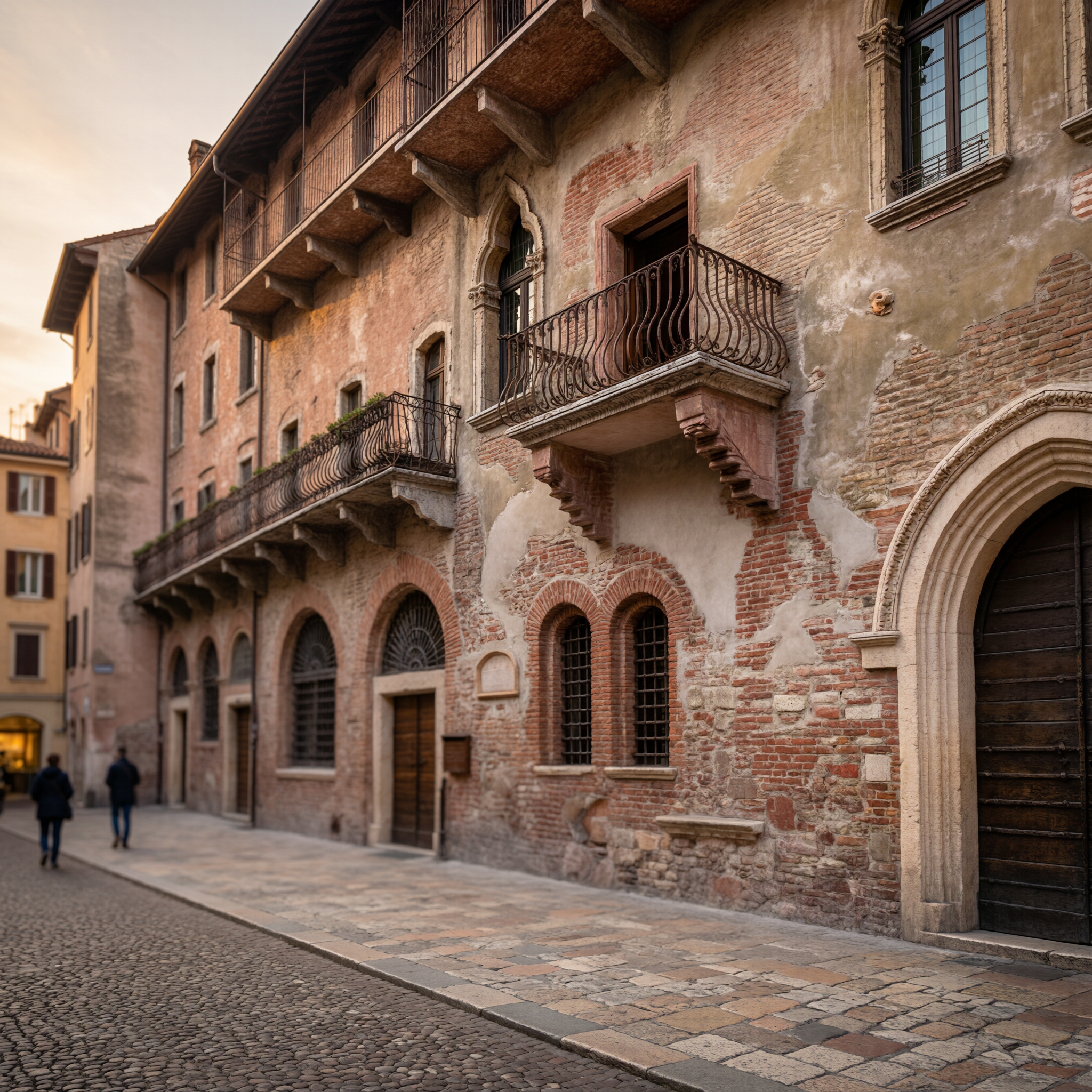
Standing in the courtyard of Verona's Casa di Giulietta, I feel a pull between romantic nostalgia and honest skepticism. The balcony overhead was assembled in 1939–1940 from salvaged 14th-century marble remains, yet it still invites you to imagine the secret meetings of Shakespeare's star-crossed lovers. Architect Antonio Avena transformed a modest medieval tower house into a global symbol of romance, and as I look up at the Gothic-style balcony, I find myself weighing the myths against the history behind this iconic spot.
Before you go: Visitor details can change. Check Casa di Giulietta e Cortile – Musei Civici di Verona and Juliet's House and Museum – Visit Verona before you go.
Origins of the Balcony
The story behind Juliet's balcony is rooted in a deliberate 20th-century effort to transform an old building into a monument to romantic legend. In the heart of Verona, the Casa di Giulietta at Via Cappello 23, once associated with the Cappello family, stands as the result of that transformation. The Municipality of Verona acquired the building in 1905 and over the following decades reshaped it to evoke Shakespeare's famous love story.
The 14th-century tower house retains a genuine medieval character, but the famous balcony is a later addition. It was assembled from Gothic marble fragments salvaged from demolished houses, not dismantled to prevent flooding, as is sometimes claimed, and installed on the facade between 1939 and 1940. The result was placed there more in the spirit of romance than of strict historical restoration.
Looking at the balcony, I find myself appreciating the deliberate blend of myth and material history. The 20th-century vision that shaped this modest house turned it into a destination for lovers worldwide. Verona's streets show how powerfully a place can be remade by collective imagination.
Antonio Avena's Vision
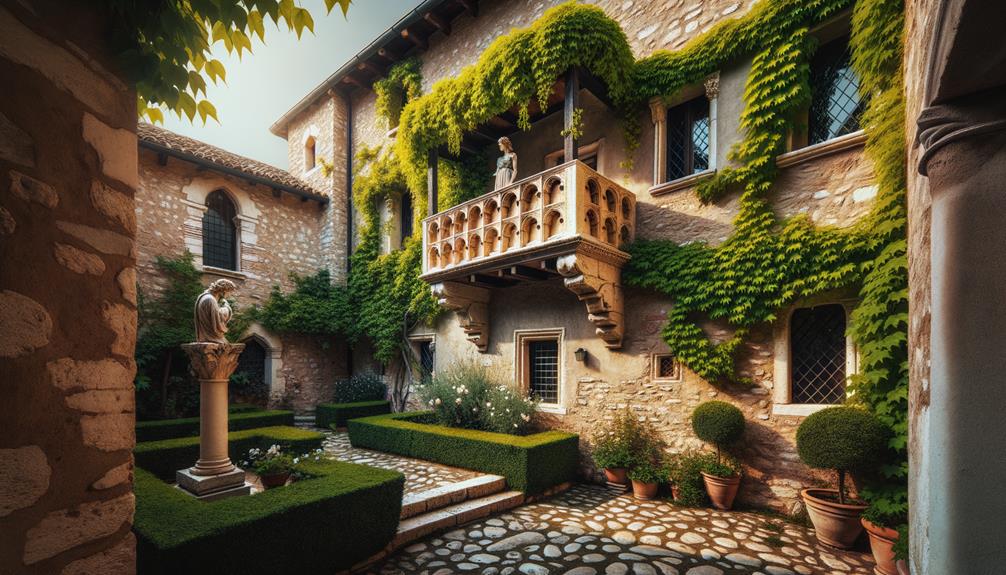
Antonio Avena, architect and director of the Verona Civic Museums, saw in the Cappello family's tower house the makings of a site where history and legend could coexist. His goal was to create an atmosphere that would resonate with visitors drawn to Shakespeare's story, and the courtyard became the centerpiece of that plan.
Between 1939 and 1940, Avena oversaw the installation of a balcony assembled from 14th-century marble remains salvaged from demolished buildings. Now known worldwide as Juliet's Balcony, it was never an original feature of the house, yet it has become one of the most photographed spots in Italy and a lasting emblem of the city's romantic identity.
Here's a glimpse of Antonio Avena's vision:
| Element | Description | Purpose |
|---|---|---|
| Juliet's Balcony | A medieval balcony placed in the courtyard | Create a romantic atmosphere |
| Courtyard | The central area of Casa di Giulietta | Serve as a focal point for tourists |
| Museum Project | Transforming the 14th-century building into a museum | Reinforce the legend of Romeo and Juliet |
Avena's legacy is the iconic Juliet's Balcony, a carefully constructed romantic gesture that has defined how millions of visitors experience Verona.
Architectural Features
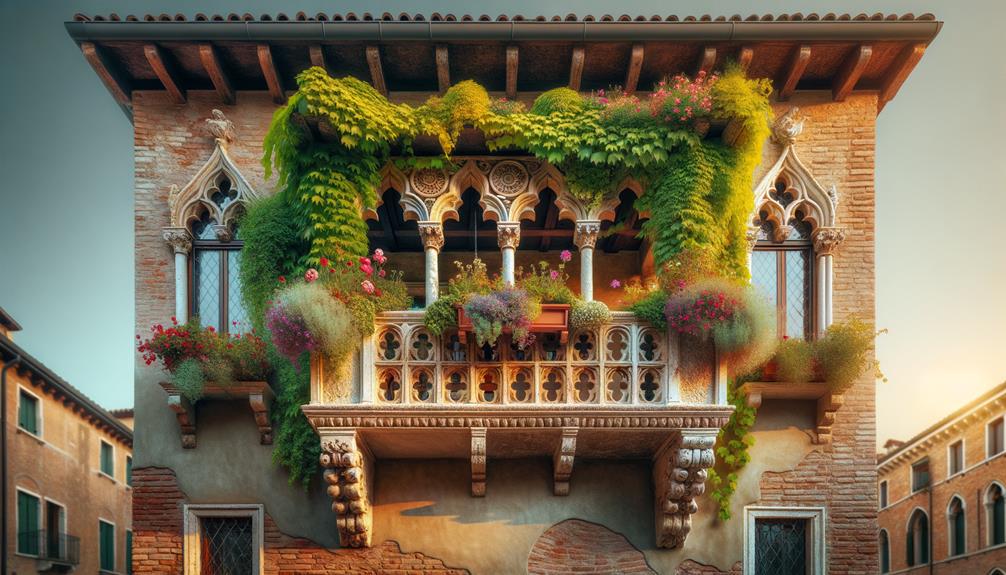
How often do we pause to consider the unique mix of history and invention that defines Juliet's Balcony? Standing in the courtyard of Casa di Giulietta, it's hard not to be drawn in by the setting. The balcony was assembled in 1939–1940 from salvaged 14th-century marble remains and set into the facade of the medieval tower house, once home to the Cappello family, that the Municipality had acquired in 1905.
The marble fragments used in the balcony are Gothic in style, characterized by the pointed arches typical of the period. Avena, as director of the Verona Civic Museums, selected and positioned the pieces to complement the building's medieval character. Inside, the museum holds Renaissance costumes and the bed used in Franco Zeffirelli's 1968 film, objects that add a tangible, if eclectic, cultural dimension to the visit.
The courtyard today is rarely quiet; it fills quickly with visitors tracing the outline of a story they already know by heart. The line between history and legend is thin here, and that tension is part of what makes the place worth seeing.
Tourist Attraction Today
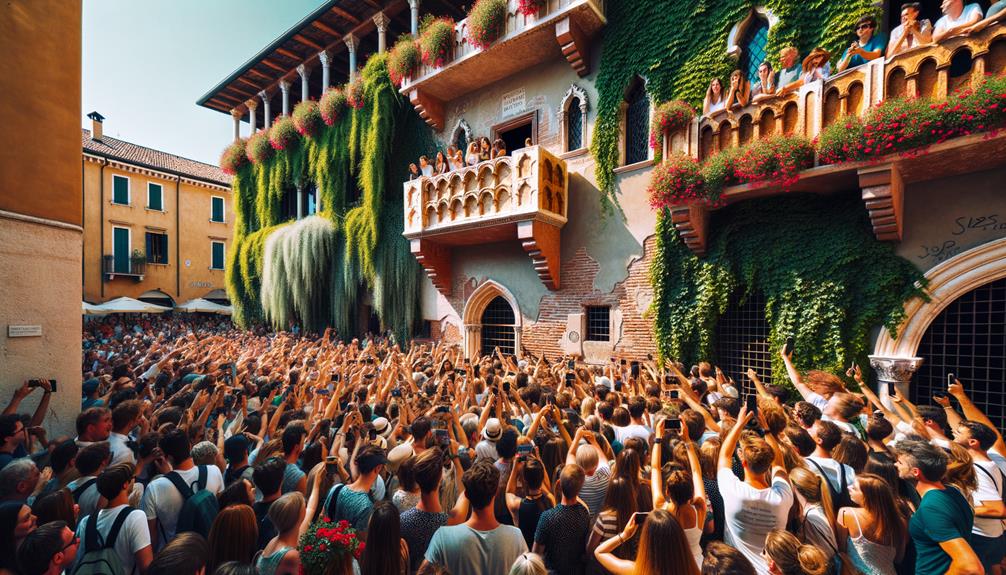
The courtyard of Casa di Giulietta draws a steady crowd, all eager to photograph the balcony or queue for a moment beside the bronze statue of Juliet. Installed in 1973 by sculptor Nereo Costantini, the statue has been rubbed smooth at the right breast by decades of visitors following the tradition that touching it brings luck in love.
Inside, the museum displays Renaissance-era costumes and the bed from Franco Zeffirelli's 1968 film Romeo and Juliet, a curious but engaging mix of literary history and cinema. The walls are layered with love notes fixed in place with chewing gum, forming an ever-growing record of visitors' hopes from around the world.
| Attraction | Description |
|---|---|
| Juliet's Balcony | Perfect spot for photos, representing romantic yearning |
| Museum | Features costumes and props from the 1968 film |
| Courtyard | Filled with tourists, includes the bronze statue of Juliet |
The courtyard walls are similarly covered in handwritten messages and gum-pressed notes. As of April 2026, entry to the site begins at Teatro Nuovo in Piazzetta Navona rather than the historic Via Cappello gate; tickets are available online through museiverona.com. Check the official site before visiting for current hours, prices, and booking requirements, as these details have changed recently and may change again.
Misconceptions and Myths
Juliet's Balcony is one of Verona's most visited spots, but the history behind it is frequently misunderstood. The balcony at Casa di Giulietta is not a 13th-century original. It was assembled from salvaged 14th-century Gothic marble fragments and installed in 1939–1940, decades after the Municipality acquired the building in 1905, with the explicit aim of giving Shakespeare's story a physical home.
There is no evidence that William Shakespeare ever visited Verona. Romeo and Juliet are fictional characters; Shakespeare drew on earlier Italian sources, principally Luigi da Porto's 1530 novella and Matteo Bandello's 1554 retelling. The story has no basis in documented historical events or real people.
The legend has grown so pervasive that it tends to overshadow the balcony's origins as a deliberate modern addition. Walking through Verona's cobbled streets, it is striking how completely fiction has fused with place, and how willingly visitors, and the city itself, have embraced that fusion.
Frequently Asked Questions
Why Is Juliet's Balcony in Verona Famous?
Juliet's balcony in Verona is famous as the physical stand-in for Shakespeare's most celebrated love scene. Although the balcony is a 20th-century construction and the characters are fictional, the site gives visitors a tangible place to connect with a story about passion, loyalty, and the cost of family conflict, themes that have resonated across centuries.
Why Do People Touch Juliet's Breast in Verona?
Touching the right breast of Nereo Costantini's 1973 bronze statue of Juliet has become a widely observed ritual, with the belief that it brings luck in love. The tradition appears to have grown organically among visitors and is now one of the courtyard's most recognized customs.
What Is a Juliet Balcony?
In architecture, a Juliet balcony, sometimes called a balconet, is a shallow railing or low barrier fitted outside a door or tall window, offering the appearance of a balcony without a usable platform. The term is inspired by the Verona balcony associated with Shakespeare's Juliet, though the architectural feature itself is distinct from the historic structure at Casa di Giulietta.
Where Is the Romeo and Juliet Balcony?
The balcony at Casa di Giulietta, Via Cappello 23 in Verona, is the site universally associated with Shakespeare's play. It was assembled from salvaged 14th-century Gothic marble fragments and installed in 1939–1940, there was never an earlier, “original” version. Romeo and Juliet are fictional characters, so no balcony connected to them predates the 20th-century construction. That said, the site itself is a genuine medieval building with a documented history, and the balcony's craftsmanship draws on authentic period materials.